Which TV Brand Is Most Reliable in 2026?
Short answer: Which TV Brand Is Most Reliable in 2026? LG leads one large US predicted-reliability survey, but the most reliable choice for you also depends on the exact model, warranty, and local service.
Consumer Reports’ survey figures, reproduced on LG’s official US reliability page, place LG first among 16 TV brands with a 94/100 predicted-reliability score. That measure estimates problems by the fifth year for new TVs purchased in a 2015–2025 sample; it is not a promise that an individual LG will last longer than every Sony or Samsung. This article separates that evidence from picture quality, owner satisfaction, and warranty so you can make a defensible choice.
Which TV Brand Is Most Reliable: What the Evidence Says
| Evidence source | Population/method | Useful finding | Limitation |
| Consumer Reports survey cited by LG | 121,881 new TVs purchased 2015–2025; predicted issues by year five | LG 94/100, first among 16; Samsung and Sony 86/100 in the cited table | Historical US owner data, not a guarantee for one 2026 SKU |
| Which? May 2026 UK TV survey | 5,911 TVs; faults, time to fault and severity | Four of 14 brands earned five reliability stars | Detailed brand scores behind membership; UK market |
| CHOICE Australia Best Brand 2025 | Model tests plus reliability and satisfaction input | LG 83%, Sony 79%, Samsung 76% composite scores | Composite ranking is not a pure reliability rate |
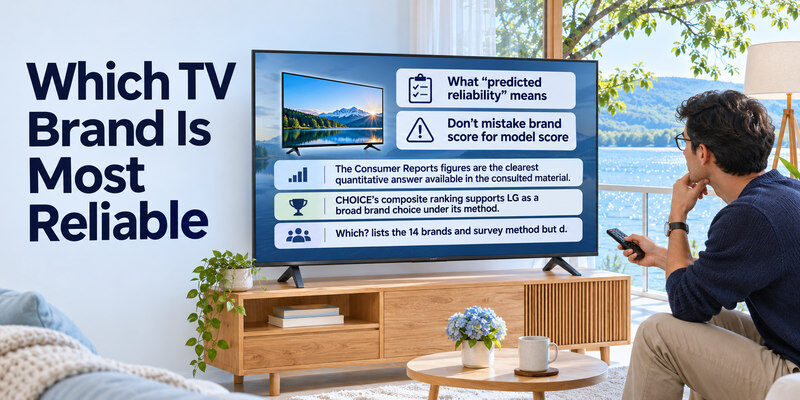
The Consumer Reports figures are the clearest quantitative answer available in the consulted material, while CHOICE’s composite ranking supports LG as a broad brand choice under its method. Which? lists the 14 brands and survey method but does not expose individual scores in its public article; it would be misleading to invent their ranking. Surveys sample past sets and owners, and results vary by country, product era, and methodology. A new 2026 model cannot have a five-year observed history yet.
What “predicted reliability” means
It estimates the chance that a newly purchased TV experiences a problem within a specified period using survey data, adjustments, and past models. It is not a laboratory life test or a precise lifespan for the unit in a box. Consumer Reports’ metric cited by LG adjusts for extended warranty/service contract status and usage. Read the methodology before comparing its 94/100 with an unrelated site’s five-star rating. To look beyond reliability scores, compare TV brands by picture, features, and support before choosing a specific model.
Don’t mistake brand score for model score
A brand sells budget LCDs, premium OLEDs, and different sizes with different components. A high average can coexist with a weak individual model. Review the exact SKU’s performance, support record, and written warranty. If possible, seek model-specific failure evidence with a stated sample size and age; a handful of one-star posts alone cannot establish a failure rate.
Read more: Best TV Under 500 Dollars: A 2026 Buying Guide
LG, Sony, and Samsung: Different Strengths
LG’s position in the cited US reliability survey makes it a reasonable first shortlist, especially when its webOS, OLED picture, and local service fit your needs. Sony and Samsung appear at 86/100 in the same LG-reproduced Consumer Reports table; that difference is not a guarantee that one individual TV will fail. CHOICE’s 2025 aggregate Best Brand list placed LG first at 83%, Sony second at 79%, and Samsung third at 76%, but 40% of that composite is average test score and only 30% brand reliability. Do not present it as a simple longevity ranking.
LG and warranty differences within the brand
LG’s official US C6 support page lists one year for parts and labor on the OLED55C6PUA. Its G6 product page states one-year parts and labor plus a five-year panel term, subject to the written conditions. A longer panel term does not mean every component or labor is covered for five years. Read the exact SKU’s region-specific PDF and any exclusions before paying more for a warranty headline.
Sony and Samsung service considerations
Both brands offer many product lines and regional support channels. Check repair availability, replacement parts, authorized service distances, and written terms where you live. A nearby technician and a clear retailer return process can outweigh a small survey-score gap. OLED versus LCD, panel size, and heat conditions can differ even within one brand. Compare a named 2026 model rather than treating a company logo as a quality certificate. If you are considering this screen size, explore 55-inch TV options for different budgets, then compare the warranty and support for each exact model.
Read more: Cheap Smart TV Review: What You Gain and Give Up in 2026
Other Brands and Value Tradeoffs
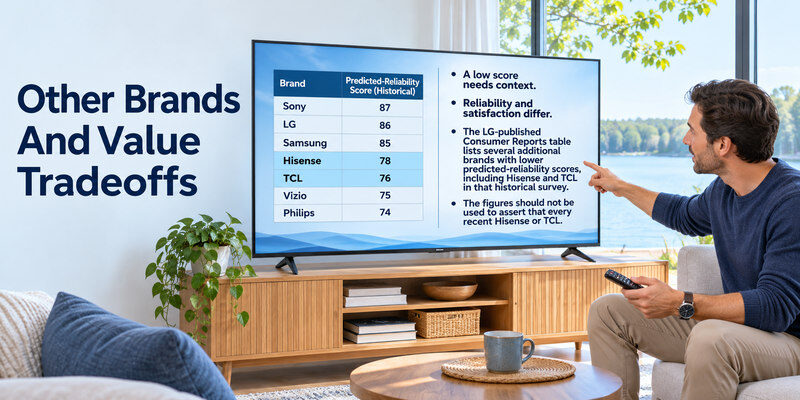
The LG-published Consumer Reports table lists several additional brands with lower predicted-reliability scores, including Hisense and TCL in that historical survey. The figures should not be used to assert that every recent Hisense or TCL model is poor or that a discounted set will fail. A budget model may offer stronger brightness, size, or gaming features per dollar. If the price gap is large, the relevant decision is expected ownership value, not merely an ordinal brand ranking.
A low score needs context
Survey responses reflect the products people bought in previous years, how they used them, and which faults were reported. New generations can change factories, boards, software, service networks, and policies. Samples also vary by brand. Use a survey to set questions for a specific purchase; then examine model reviews, warranty, current repair access, and the retailer’s return period.
Reliability and satisfaction differ
An owner may love a bright picture despite an app crash, or dislike a reliable TV’s interface. CHOICE’s Best Brand method explicitly blends test scores, reliability, satisfaction, and recommendation ratio. Which? likewise distinguishes customer score from faults. Read which measure a “best brand” badge represents. A high performance score is not the same as a low failure rate.
Read more: OLED vs QLED Comparison: Which TV Fits Your Room and Use?
The Faults Owners Actually Face
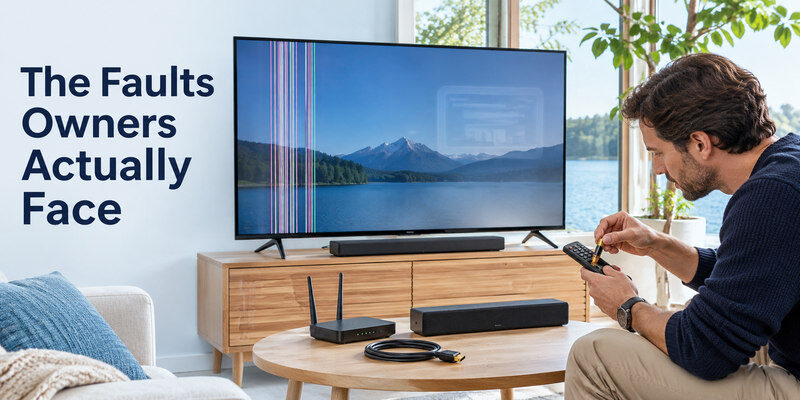
A TV can develop a power issue, backlight or panel defect, sound problem, input failure, remote issue, or software slowdown. Some symptoms are external: a loose HDMI cable, a failed soundbar, weak Wi-Fi, or a dead remote battery can make a healthy TV seem broken. Diagnose before paying for a replacement. Which?’s consumer guide discusses audio and hardware failures among common categories, but do not assign a precise frequency without accessible data.
Separate accessory failures from TV failures
Test the TV’s physical power button and another outlet before concluding its panel failed. For “no signal,” try another HDMI input and a known-good cable. For no audio, switch temporarily to TV speakers. For slow apps, check network and firmware. Those checks avoid misclassifying a peripheral issue as brand unreliability. Keep your receipt and serial number for service.
Screen defects and image retention
LCDs can have backlight, uniformity, or board issues; OLEDs can have uneven pixel wear with prolonged static content. Neither technology is immune to failure. Follow manufacturer care settings, allow ventilation, and avoid leaving the TV in harsh heat. A single online burn-in photograph cannot establish a brand-wide defect rate. Warranty coverage depends on the written policy and usage. For a closer look at the tradeoffs, learn what to look for in a budget smart TV, including picture quality, software, and return terms.
Warranty and Repairability Matter as Much as a Ranking
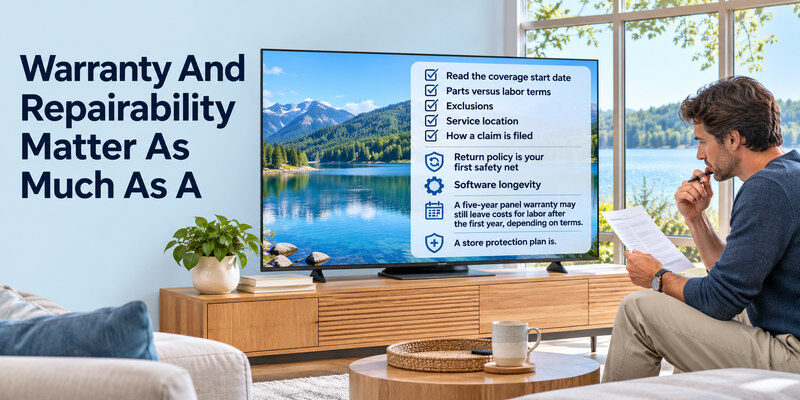
Read the coverage start date, parts versus labor terms, exclusions, service location, and how a claim is filed. A five-year panel warranty may still leave costs for labor after the first year, depending on terms. A store protection plan is separate from a manufacturer warranty. Ask whether a technician visits for a large TV or whether shipping is required. Confirm who pays for removal from a wall mount.
Return policy is your first safety net
A new set’s immediate panel defect or shipping damage is easier to handle during a clear return window. Inspect packaging at delivery and test the TV soon. Use normal picture mode to check dark scenes, bright uniform scenes, HDMI inputs, Wi-Fi, speakers, and remote response. Document any real defect per the retailer’s process. Keep the box until the return window closes if practical.
Software longevity
A working screen can outlast its built-in app platform. Ask about update commitments and current app availability for the exact model, not the brand in general. An external streaming device can refresh apps, but it cannot fix hardware failure, missing HDMI input, or a dim backlight. Keep the TV’s firmware current when the manufacturer releases relevant fixes.
Read more: How to Connect Xbox to TV: HDMI, 4K, 120 Hz, and Sound
A Practical Reliability Checklist for a New TV
- Choose the size and panel that fits the room, then shortlist exact models.
- Compare a current, transparent owner survey with its geography and age range.
- Read independent exact-size performance and defect reports carefully.
- Check the manufacturer’s written warranty and local authorized service.
- Confirm the retailer’s damage, return, and dead-pixel policies.
- Test picture, sound, ports, network, and remote during the return window.
A remote failure is easier to solve than a failed main board, and the cost differs. A compatible can provide phone control for supported TVs after setup if the physical remote is lost, but it cannot repair a nonworking TV or network. Weigh the severity of likely problems, not simply their number.
Calculate value, not an imaginary lifespan
No credible source can say a specific new TV will last exactly seven, ten, or fifteen years. Compare current price with warranty, repair route, power use, and picture quality. A cheaper set with a shorter practical life could still be rational for a guest room; a main living-room TV may justify a stronger warranty and service network. Avoid multiplying a survey score into an unsupported yearly cost formula.
Revisit evidence when buying
As of November 2026, Consumer Reports, Which?, and CHOICE use different populations and time windows. Search the latest published methodology before quoting a rank in the future. Manufacturer pages may selectively highlight favorable results, so consult the underlying research when accessible. The LG page accurately provides a cited score but is still a brand’s promotional page.
TV Reliability FAQ
Does LG always last longer than Sony or Samsung?
No. LG leads the cited aggregate predicted-reliability survey, but an individual model’s outcome cannot be guaranteed. Sony and Samsung have different lines, terms, and service options. Compare exact models and local support.
Is OLED less reliable than LED?
There is no universal answer from the consulted brand surveys. OLED pixel wear under static use differs from LCD backlight issues, and other parts can fail in both. Check model-specific evidence and warranty terms.
What is the longest-lasting TV brand?
No brand has a guaranteed lifespan. In the consulted US predicted-reliability data, LG ranks first, but that predicts issues by year five from historical purchases. Actual longevity varies by model, usage, environment, and repair access.
Are cheap brands automatically unreliable?
No. A lower aggregate survey score is a useful risk signal, not a verdict on every model. A particular discounted TV may be good value if its performance, warranty, and return terms fit your needs.
Does a longer warranty prove better reliability?
No. It changes what the manufacturer promises to cover, often with exclusions. Read parts, labor, panel, and service conditions. A five-year panel term may not cover the rest of the TV for five years.
How to Read Reliability Data Without Overclaiming
Survey period and geography
Consumer Reports’ cited US predicted-reliability sample covers purchases from 2015–2025, while Which?’s public UK article describes a May 2026 survey of 5,911 TVs. These are different populations and time windows. A model launched in 2026 cannot yet contribute five years of observed failures. When answering which tv brand is most reliable, state the survey’s age and country alongside the score. Local repair networks and warranty law also change the practical outcome of a failure.
Composite rankings versus pure fault rates
CHOICE Australia’s 2025 Best Brand score combines average test results, brand reliability, customer satisfaction, and recommendation ratio, with weights of 40%, 30%, 20%, and 10% respectively. LG led that composite at 83%, Sony had 79%, and Samsung 76%. Those figures do not mean 83% of LG TVs survive or that LG’s fault rate is 4 points lower than Sony’s. Which tv brand is most reliable is a different question from which brand makes the best overall picture at a price. Use the measure that matches your decision.
Severity and repair path
A faulty remote battery, intermittent Wi-Fi, failed speaker, and dead panel are not equivalent ownership events. Ask how a study counts problems and whether severity and time-to-first-fault matter. Which? says its reliability method incorporates fault timing and impact. The answer to which tv brand is most reliable should therefore include the type of issue and how a buyer can get service locally. A convenient authorized repair center may reduce disruption even when two brands have similar predicted rates.
Warranty terms on the exact SKU
LG’s US C6 support page lists one year of parts and labor for the cited 55-inch model; its G6 product page advertises a separate five-year panel term with conditions. A buyer should read the actual warranty PDF for the purchased size, country, and retailer. Panel coverage may not cover labor or electronics throughout the same period. Which tv brand is most reliable is not answered by the largest printed year number. The return window handles immediate damage; the manufacturer warranty handles covered defects later.
A realistic ownership plan
Choose a model that meets picture and port needs, then inspect survey evidence, warranty, repair access, and total price. Keep the receipt and serial number, update firmware through official channels, and allow ventilation. If a TV loses apps while its panel remains healthy, an HDMI streamer may extend its useful life. If a physical remote fails, a supported phone app can be a temporary workaround. No survey can guarantee that one unit will last ten years; avoid a promise that the data cannot support.
Final Thoughts
If you ask which tv brand is most reliable, LG is the evidence-backed first answer from the large cited US survey. It is still wise to compare the exact model, full warranty, repair options, and a current independent review. A transparent survey is more useful than an unsupported “lasts ten years” claim, and a good return policy protects the purchase from an early defect.